
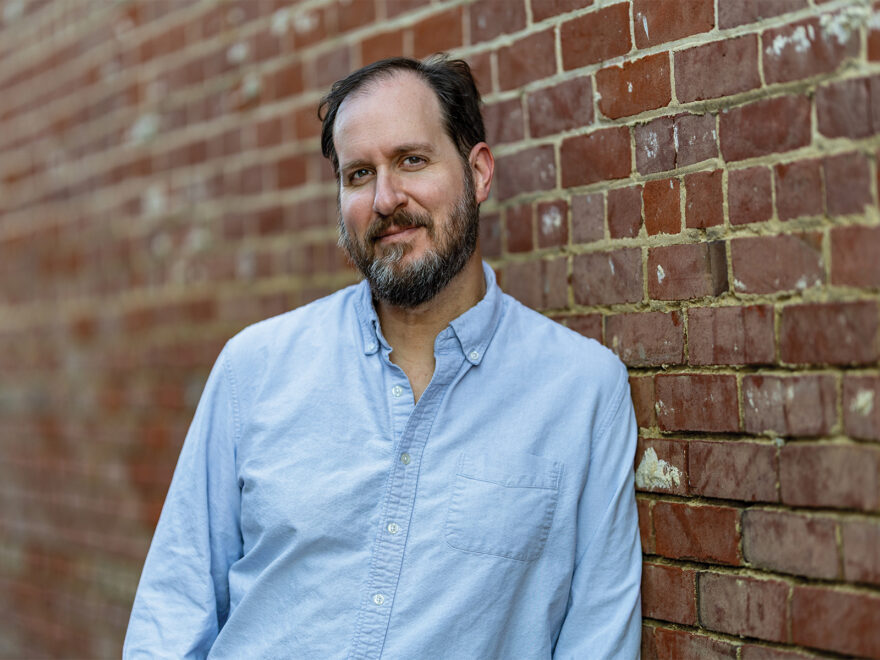
McManus Woodend has been a GEICO Caveman, filmmaker, professor and world traveler. These days, one of his favorite roles is simply calling Henderson home
Photo by WILD WILD LIGHT PHOTOGRAPHY: MANDY SUE GLASER
There probably aren’t many college professors who can say they once spent 25 straight hours covered in prosthetics and hair. Even fewer can say they landed a national advertising campaign after finding a casting notice online, flew to Baltimore on a sick day for an audition they weren’t entirely convinced was real, worked alongside Billie Jean King and the stars of “Deadliest Catch,” studied under legendary filmmakers in Switzerland, and eventually settled down in Henderson, Kentucky.
But then again, there aren’t many people quite like McManus Woodend — or, as his résumé might suggest, Dr. Caveman.
To Woodend’s slight surprise, and perhaps relief, his students at the University of Southern Indiana haven’t made that nickname stick.
“These days, the real McManus Woodend has a Ph.D., so I get to throw that out in ultra-formal settings,” he joked. “But I’m not that kind of doctor.”
Today, Woodend is an assistant professor of digital media at USI, as well as a filmmaker, husband and father. But to millions of television viewers, his face — or at least a heavily transformed, considerably hairier version of it — is familiar for another reason.
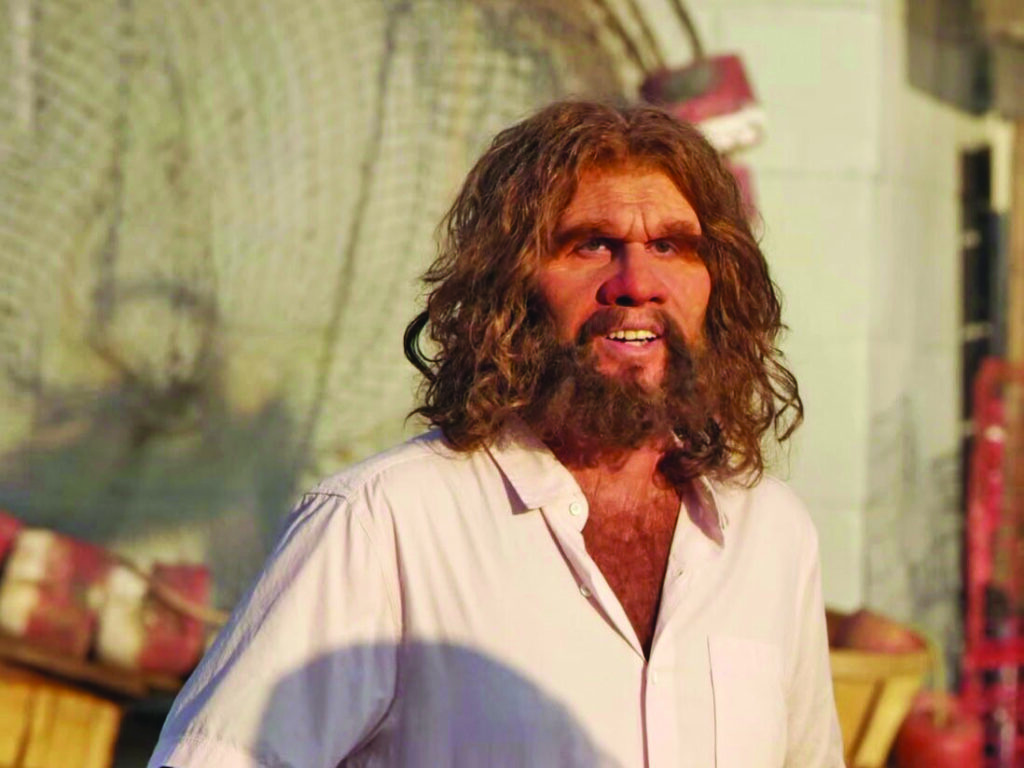
For a decade, Woodend was one of the actors behind GEICO’s famous Caveman. The story of how a filmmaker from Florida ended up underneath all that hair before eventually making Henderson home is almost as entertaining as the commercials themselves.
Before Henderson entered the picture, there was New York City, where Woodend met his wife, Kelli, while he was working on a movie. Kelli happened to have a pretty memorable job of her own: She was working with The Muppets.
The two were engaged a year later, married at Lake Barkley the following year and eventually welcomed their son, Rohmer.
Before Rohmer was born, the couple left New York and headed south. Woodend grew up on Florida’s East Coast in Satellite Beach, and he and Kelli lived in Melbourne and Sarasota before deciding to make another move, this time to Kelli’s hometown of Henderson.
The decision was largely about family. They wanted Rohmer to have the opportunity to grow up near his many cousins and experience the closeness that comes with having extended family nearby.
Of course, Henderson had another selling point that carried surprising weight with Woodend: Family Video.
“My first impression of Henderson was one of excitement because, at the time, there was still a Family Video location,” he said.
As a huge advocate for physical media, particularly movies, Woodend admits the video store was a legitimate perk of relocating. Family Video may be gone, “RIP,” as Woodend put it, but his appreciation for Henderson has only grown.
He has watched the energy surrounding downtown revitalization and appreciates the city’s commitment to giving people reasons to come together, particularly through the festivals and community events that fill the warmer months.
That sense of community, paired with a slower pace of life, has proven to be a good fit for someone whose career has taken him from movie sets and major cities to classrooms in Europe.
“The way of life is much less chaotic,” Woodend said.
At the same time, Henderson’s location means the family doesn’t have to give up the things they enjoy about larger cities. When they get the itch for a faster pace, a different culture or simply a weekend away, several major cities are close enough to make that possible.
Woodend’s journey into acting was every bit as unconventional as the rest of his story.
He performed in community theater from ages 9 to 13 while living in Michigan, but when his family moved back to Florida, acting essentially disappeared from his life. He wouldn’t return to it until his late 20s, when he was far more interested in making films from behind the camera than appearing in front of one.
Then, in 2008, he stumbled across a casting notice on the Virginia Film Office website while working at his alma mater, Full Sail University, with a headline that was difficult to scroll past: “Do You Wanna Be a Caveman?”
Initially, he wondered whether the whole thing might be fake, but late on a Sunday night, he decided to submit anyway. Before noon the next morning, a casting agent called and asked whether he was serious about auditioning.
Woodend figured that if she was serious enough to call, he was serious enough to go along with it.
Her response quickly raised the stakes: “Great! I’ll see you in Baltimore on Wednesday!”
There was one rather significant complication: Woodend was in Orlando.
So he did what any aspiring Caveman apparently does. He took a sick day from work, bought a last-minute plane ticket and flew to Baltimore, making sure friends and family knew exactly where he was headed just in case this strange internet casting call ended with an abduction rather than an audition.
He arrived safely, performed the entire audition in character and headed home, believing his brief adventure in Caveman casting was over.
Four months later, the phone rang again.
Woodend had been invited back for another round of auditions, this time alongside six other actors. When he walked into the room and saw his competition — impeccably groomed and dressed like maître d’s at an upscale restaurant — Woodend remembers having a realization.
“I either really have this or I really don’t.”
A week later, he learned he really did.
Woodend landed the role in August 2008, emerging from a pool that included more than 1,000 actors. What began as a casting notice he nearly dismissed as fake turned into a decade-long run, with Woodend portraying the GEICO Caveman through 2018.
Getting the part, however, was only the beginning.
Becoming the Caveman was a production all its own, and anyone who imagined Woodend simply threw on a wig and added some fake facial hair would be seriously underestimating the process.
A typical transformation required about three hours in the makeup chair and included a full facial prosthetic, facial hair, a wig, and hair applied to his arms and hands. If a commercial called for exposed legs or a chest, the process could stretch to four hours or longer. At the end of the day, removing everything required another 90 minutes.
The longest Woodend ever remained in full Caveman makeup was an incredible 25 hours.
Helping create that transformation was Woodend’s primary makeup artist, Tony Gardner, whose Hollywood résumé makes the story even better. Gardner’s work has included the “Child’s Play” franchise, Daft Punk’s iconic robot helmets and special makeup effects for Michael Jackson’s “Thriller” music video.
The elaborate makeup was only one small piece of what went into producing the commercials. A spot viewers watched in a matter of seconds could involve more than 100 people working behind the scenes.
“I was just one small part of a much larger creative engine,” Woodend said.
Because Woodend already understood filmmaking from behind the camera, his involvement gradually extended beyond simply arriving on set and becoming the Caveman. As the GEICO team became familiar with his production background, they included him earlier in the creative process and encouraged him to improvise during filming.
Unofficially, Woodend said seven actors portrayed Cavemen in the commercials over the years, while three others appeared in the short-lived television series in 2007.
Among his favorite experiences were commercials with tennis legend Billie Jean King and a History Channel spot titled “HR,” directed by Krista Liney.
And sometimes, when the phone rang, it sent him somewhere entirely unexpected.
One of his most memorable adventures came when he traveled to Alaska to film with the Hillstrand brothers from “Deadliest Catch.” What was supposed to be a relatively relaxed five-day production was quickly condensed into a frantic two-day shoot as blizzards, avalanches and other forces of nature complicated nearly every plan.
Despite the chaos, the “Deadliest Catch” campaign, created with writer, producer and director Don Cherel, remains one of Woodend’s favorites.
By the time Woodend filmed his final Caveman commercial, his life and priorities had begun moving in a different direction.
When he met Kelli, he was finishing his first feature film, “Rocksteppy,” while also nearing the end of his doctoral coursework. His years in New York had given him opportunities to work alongside actors and directors his teenage self never would have imagined meeting, but as his career evolved, his priorities began to shift.
Filmmaking remained important, but completing his doctoral dissertation and embracing life as a father increasingly took center stage.
Woodend earned his Ph.D. through The European Graduate School in Saas-Fee, Switzerland, an experience that allowed him to continue living and working in the United States while traveling to Europe each summer for classes.
His professors included acclaimed filmmakers Terrence Malick and Wim Wenders, adding yet another unexpected chapter to a career that had already taken him from behind the camera to national television.
For someone who walked away from acting at 13 and didn’t return until his late 20s, Woodend had found himself on a path he never could have planned.
That path continues today, although now some of his creative work is happening much closer to home.
Recently, Woodend produced and appeared in “Only the Lord Will Set You Free,” a short film shot in Henderson that has been selected for the 2026 Nashville Film Festival. The project brings together two important parts of his life — his longtime passion for filmmaking and the community where he and Kelli chose to raise their family.
Professionally, Woodend now spends his days helping the next generation of storytellers find their own creative paths as an assistant professor of digital media at the University of Southern Indiana. The role brings his years of experience as a filmmaker, performer and student of the craft into the classroom. In fall 2027, Woodend will oversee the new USI Film track as part of the revamped Communication & Media degree program.
There is, however, at least one part of his background that probably doesn’t make it into the syllabus: Woodend comes from a family of singers. His sister spent 10 seasons as an opera singer with the Metropolitan Opera in New York City, and while he may not have followed her onto the opera stage, Woodend says he can still hold his own at karaoke.
Looking at Woodend’s résumé, Henderson might seem like an unexpected place for his story to land. Yet after years spent on movie sets, in major cities and traveling abroad, Henderson offered Woodend and his family something they were ready for — a slower pace without giving up a strong sense of community.
It gave Rohmer the chance to grow up surrounded by cousins. It gave the family festivals, traditions and a community to enjoy together. In many ways, Henderson fits a life Woodend himself describes as “conventionally unconventional.”
Millions of people may still recognize him as one of the faces behind the campaign that made “So easy a caveman could do it” part of pop culture. He still tends to let his hair and beard grow from time to time but always cuts it when the look gets a little too Cro-Magnon.
These days, though, Woodend is more interested in the life he has built outside the character.
The Caveman may have left his career in 2018, but Woodend is nowhere near his final scene.
For this chapter, Henderson is home.
Learn more about McManus Woodend and his work at www.mcmanuswoodend.com.
 Calling all Hendersonians!